

Frozen lake Childir with sleigh tracks
Image: Mukti Mitchell
The Joy of Going Slow – Georgia to Kazakhstan
The journey to India, for which I’d waited 15 years for the time to travel by land, is half complete as I reach the Republic of Georgia.
This is part 3 of my low carbon journey, read Part 1: The Joy of Going Slow – England to Greece by Bike and Part 2 of my eco-travelogue: The Joy of Going Slow – Greece to Turkey.
To protect themselves, the Chinese built the Great Wall of China, the English built Hadrian’s wall and Trump wants to build a wall, but the Georgians asked God to build the North and South Caucasus mountains, and Georgia’s fertile lands lie nestled in between.
And cycle to snowy Georgia I did. Late last March I rode from Kars in Northeast Turkey past a frozen lake Childir, where the tracks of horse-drawn sleighs could be seen on the ice. I awoke in a Georgian fir-wood with snow all over my tent, pedalled through shining white mountainscapes, and at the highest pass got icicles on my beard. Luckily the human body is a fantastic eco-system and I was mostly warm and cosy inside. From the South Caucasus I gazed across Georgia to the North Caucasus ridge – a line of snowy peaks the length of the horizon. The final descent to the capital is 20km downhill, and in half an hour the snow was forgotten as I entered the sun-drenched streets of Tbilisi, which means “warm place”.
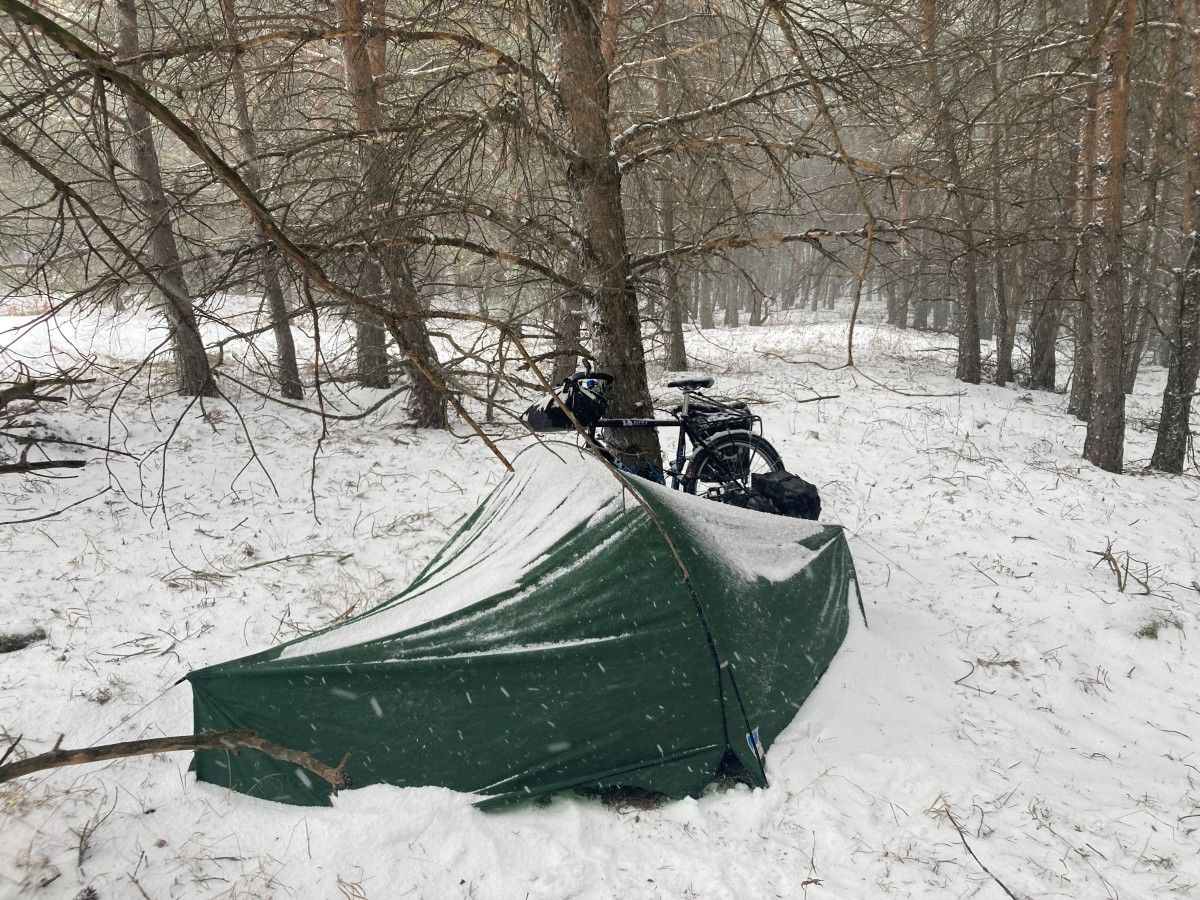
Waking up with snow on my tent in a Georgian forest
Image: Mukti Mitchell
I had by now come to understand that what my inner compass points towards is a good atmosphere. I was nevertheless surprised that before I had even got off my bicycle a little voice in my head said “Well I could just cancel the trip and stay here for the rest of my life!” The wonderful thing about an atmosphere is that you can feel it instantly, and it said infinite things about what was going on down all the little back streets I was yet to explore. As Antoine de Saint-Exupéry says in The Little Prince, “One sees clearly only with the heart. What is essential is invisible to the eye”.
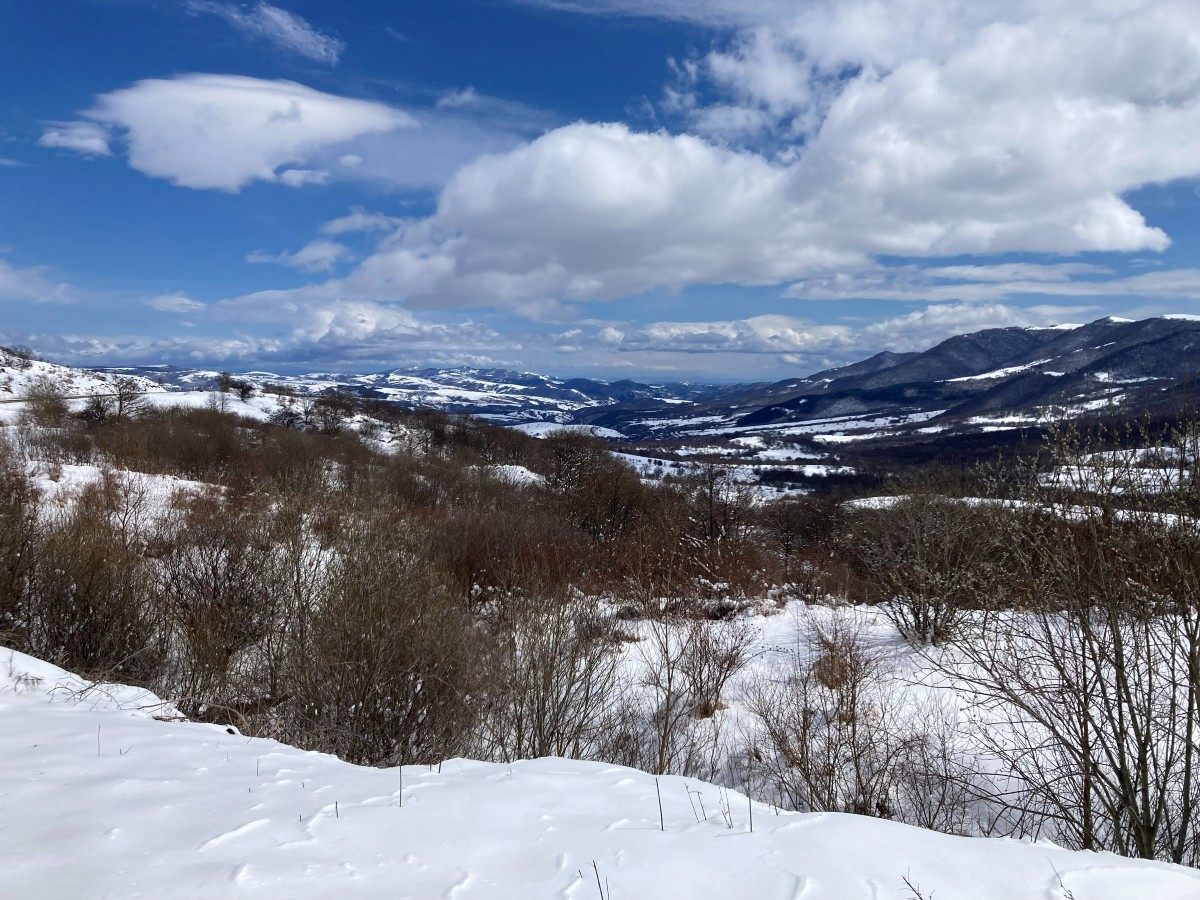
Through Georgia’s beautiful snowy mountains
Image: Mukti Mitchell
The moving sounds of Rumi’s Sufi musicians were fresh in my mind when I was invited to a rehearsal of the Georgian polyphonic choir, Ialoni. Despite not understanding a word, I sat and quietly wept through song after song without knowing why. Ialoni means sunrise, and this female choir is led by Nino Naneishvili who fell in love with singing in Tbilisi’s churches when she was 5 years old. A few days later I cooked the choir of 16 an Indian meal and a friendship began that would carry on through a long, relaxed summer.
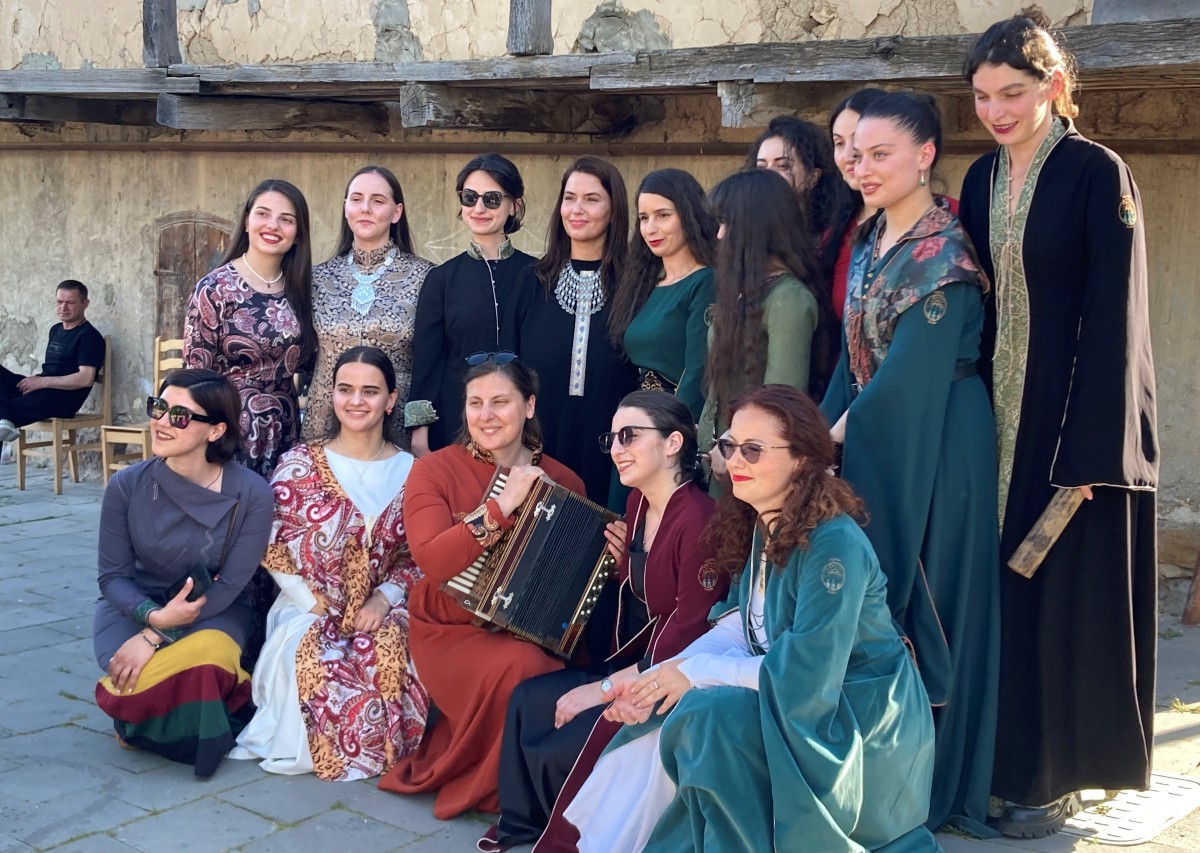
The Georgian polyphonic choir, Ialoni, meaning sunrise
Image: Mukti Mitchell
Acting with great inefficiency, it took me two months to research my onward route and gather the necessary visas. However during the process I had the great good fortune to obtain rare permission to enter Azerbaijan by land, on account of my mission to travel sustainably.
By this time I was enjoying life in Tbilisi so much that I reasoned it was better to wait out the summer heat of the Kazakh and Uzbek deserts. I found the Georgians wonderfully authentic and relaxed. I detected a sweetness in their conversations that spoke of a gentle care for each other and, despite many challenges, conveyed a sense of being in it together. Communication studies taught me that 70% of a message is non-verbal, and the tones of their voices spoke volumes to me.
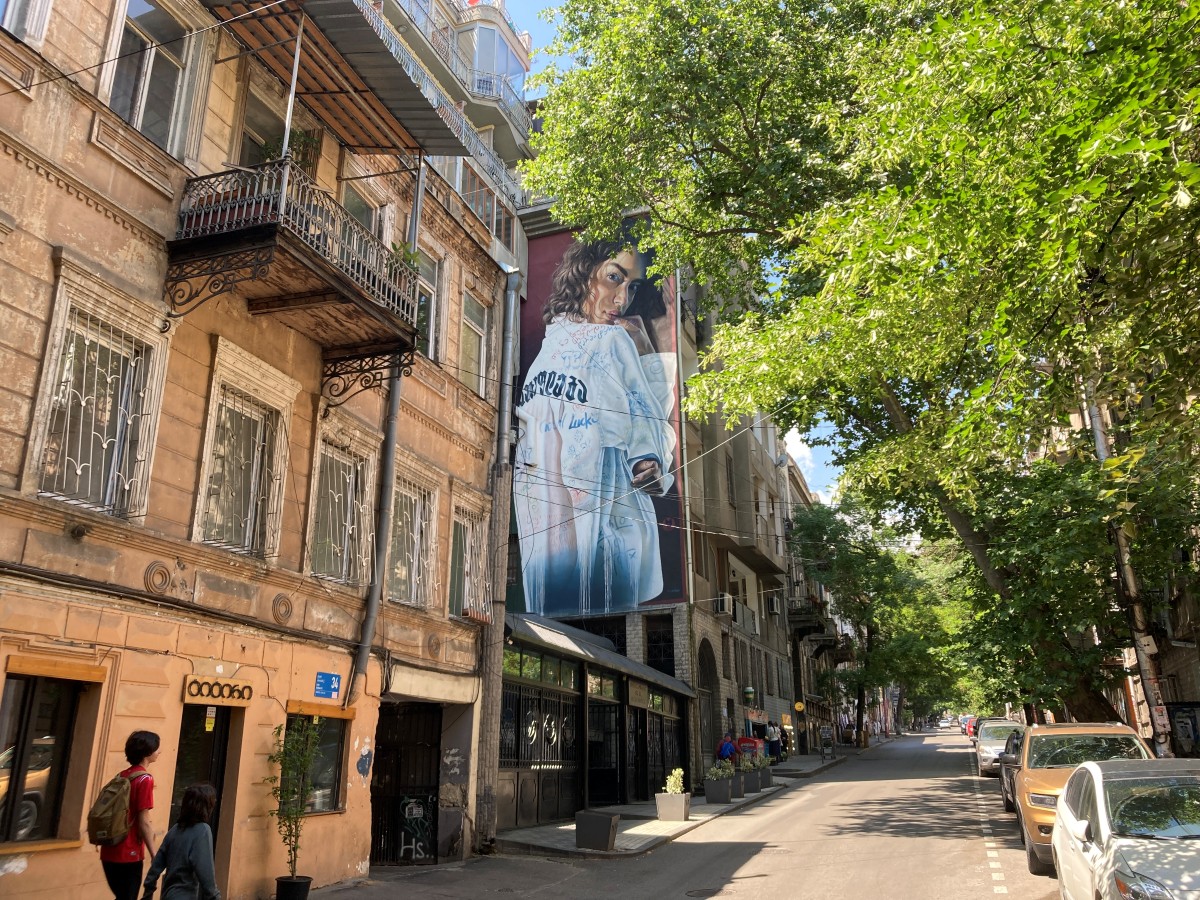
Ornate balconies and fine graffiti in Tbilisi’s tree-lined streets
Image: Mukti Mitchell
Georgia’s national gallery houses a media library in the basement, where I sheltered from the summer heat to work on my book. I balanced my quiet city life with excursions to swim in the Black Sea and trek in the North Caucasus. There I found bilberries and orchids of Dartmoor and saw my first cuckoo and golden eagles.
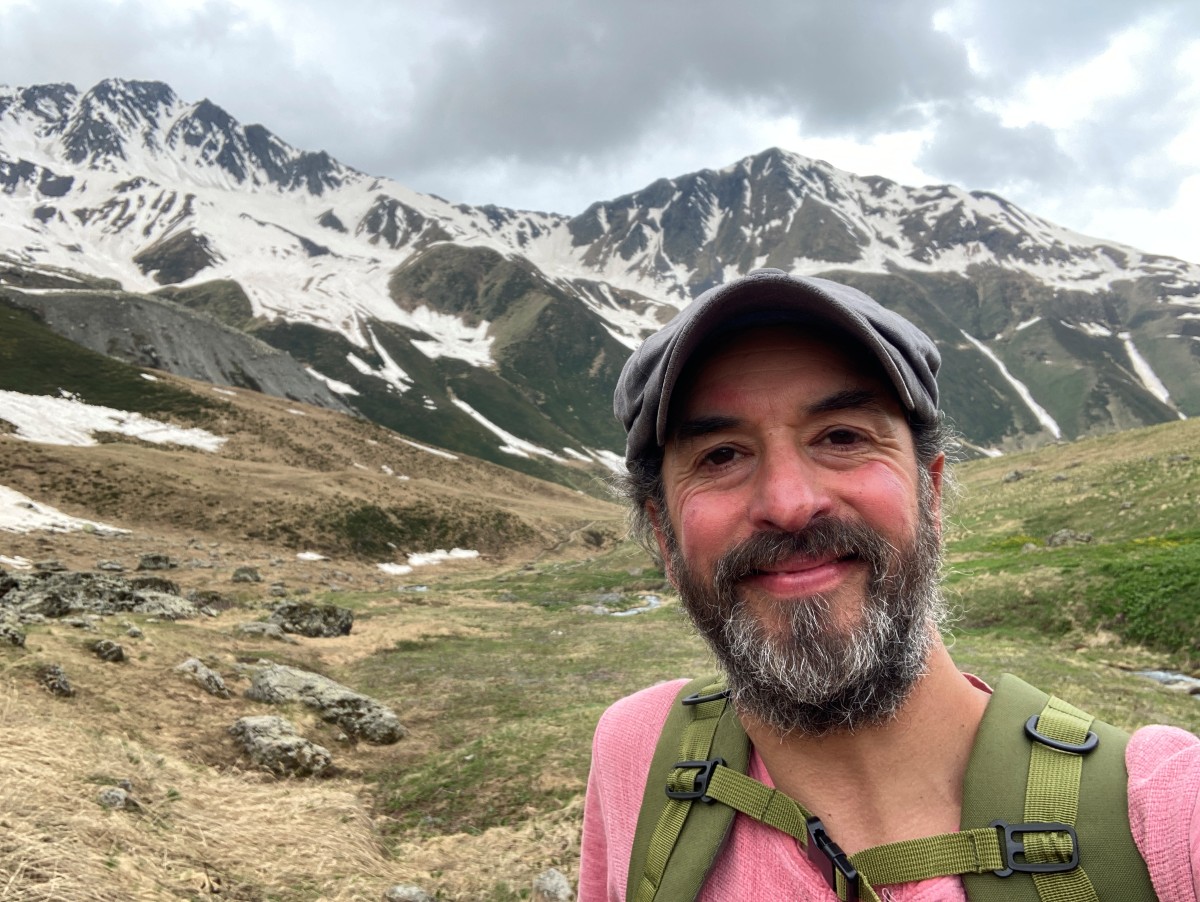
Trekking in the North Caucasus mountains
Image: Mukti Mitchell
Accompanying Ialoni on a tour of Western Georgia took us to a distant mountain farm that is so high its family could retreat there to escape the Bolsheviks. The only disadvantage they said was that one couldn’t go out walking alone on account of the number of bears around, and one surprised our host in the back garden while we were there! Although the family’s great grandfather chose to escape the Bolsheviks, the present generation remember the soviet days with great affection. They report that life was easier, better and richer than today, with a stronger sense of community and many more parties! However today’s young generation prefer the pursuit of greater political freedom. I came away feeling the communist experiment had many merits, even if it didn’t have all the answers.
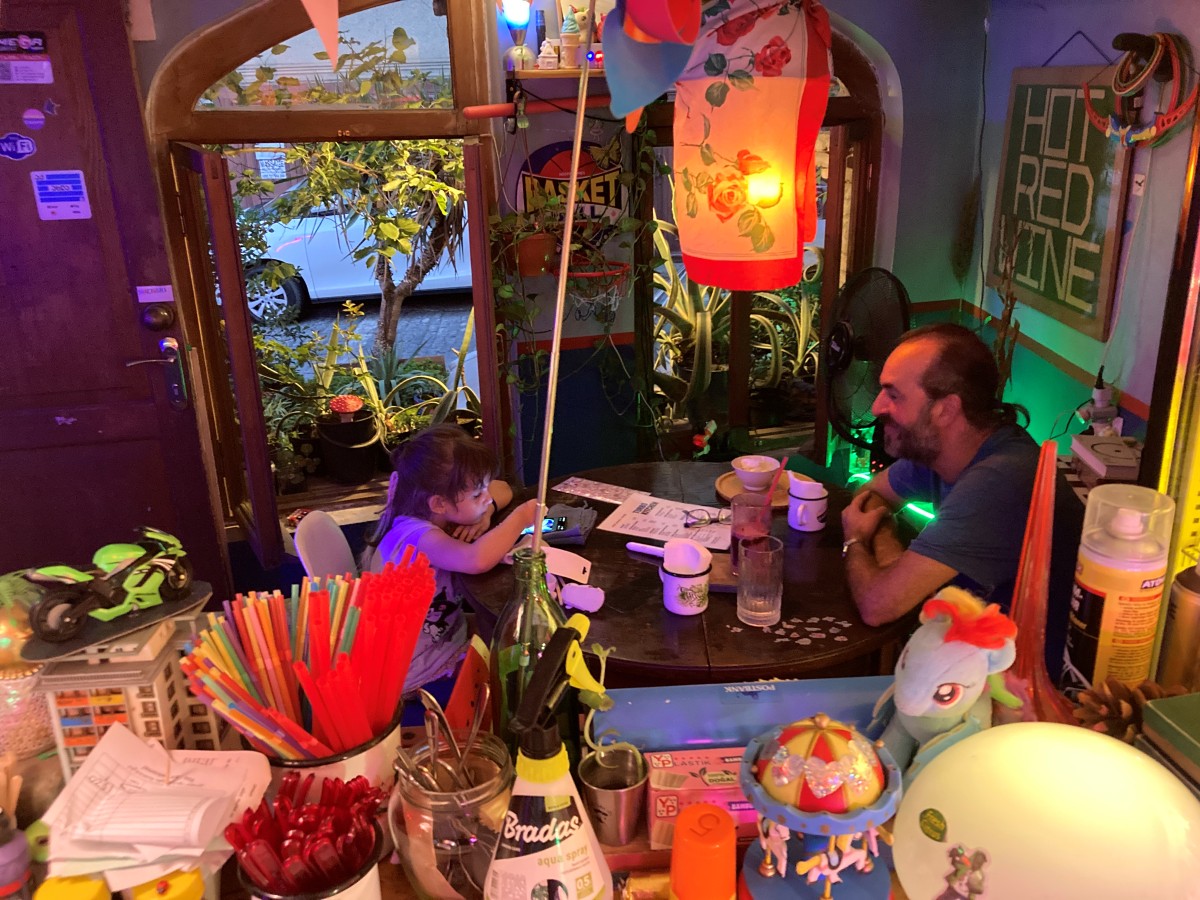
Inside the art at Carpe Diem Café
Image: Mukti Mitchell
The Georgian summer indulged me with abundant strawberries, raspberries, blueberries and watermelon. Its spell was deepened by tango and five-rhythms classes and milkshakes from hand-pressed fruit syrups served in a cafe that embodies the art of life. I developed an addiction for Churchkella (sorry we don’t have a way to write the correct pronunciation!), which is made by dipping a string of walnuts in grape juice thickened with flour. The result is a kind of handmade, sugar-free snicker bar 🙂
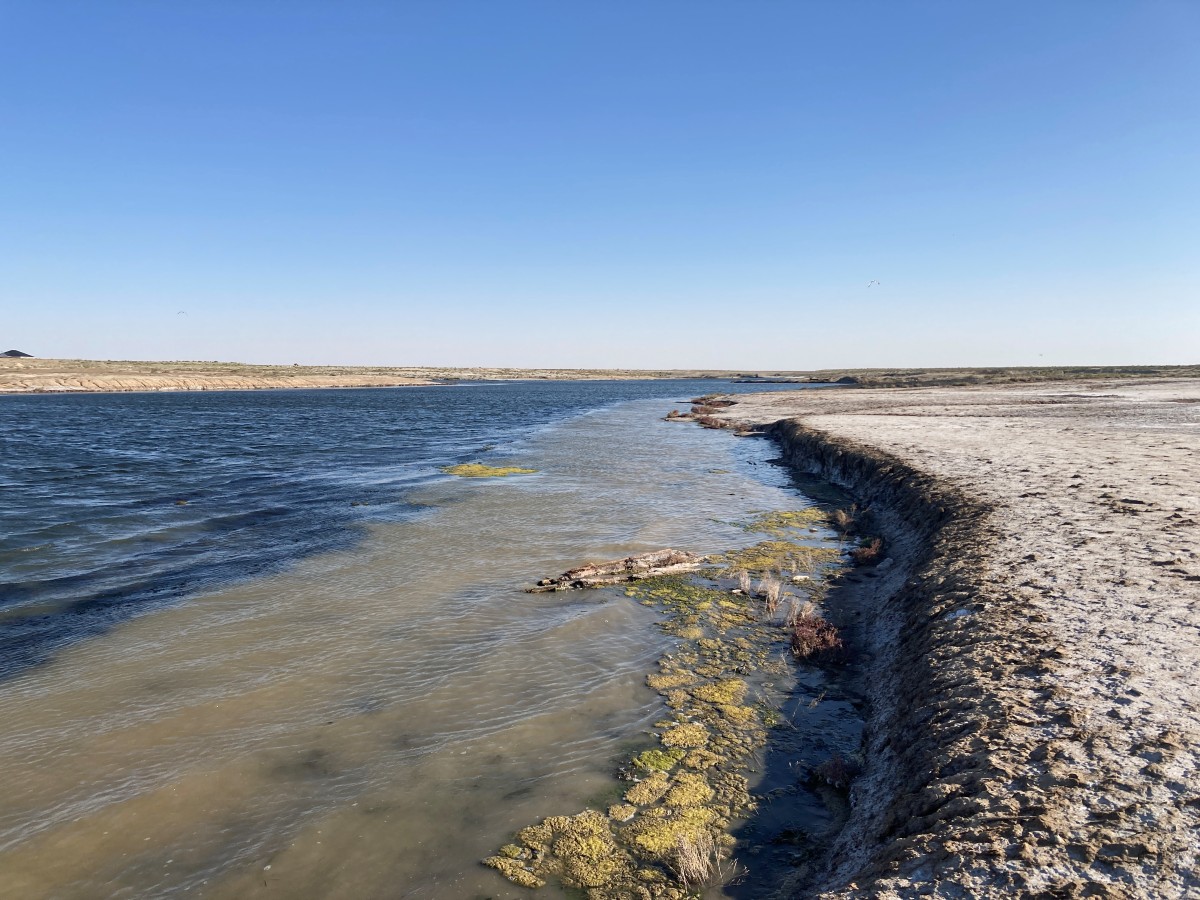
Catastrophe to success – water returns to the dried up Aral sea
Image: Mukti Mitchell
As autumn approached, I could hear the call of India. I wanted to get there in time to meet my father on what may be his last trip since he’s 90 next year. So on 25th August I set off by busses through Azerbaijan and a wonderfully smooth ferry ride across the Caspian Sea. I discovered a little brother to the Trans-Siberian Express, offering a 55-hour journey the length of mighty Kazakhstan. From the restaurant car, the plains of the great Kazakh desert rumble by at a pace that matches the mood of the camels who nonchalantly chew desert scrub as they contemplate our passage. Ahead of me on the ancient silk roads lie China, Tibet and Nepal before India.
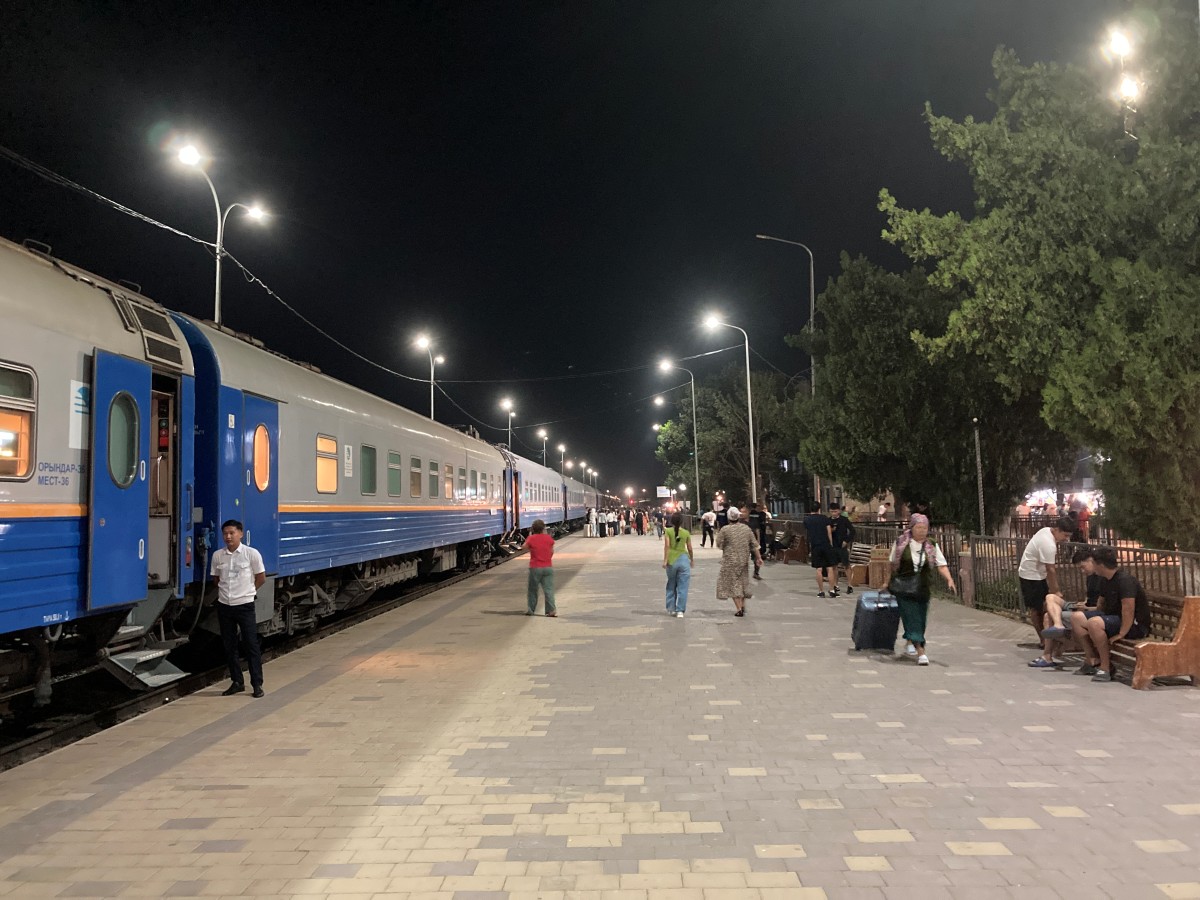
Little brother to the Trans-Siberian (the 55-hour Kazakh Express)
Image: Mukti Mitchell
I continue to be surprised by what a positive effect my choice of transport has had on my experience. As well as saving 4.5 tonnes of CO2 emissions (14 tonnes business class) compared to flying, the slow pace of land travel helped me develop a sensitivity to the atmosphere of places I visit. In turn, following a good atmosphere has led me to some of my most enjoyable experiences. The rule holds true that my quality of life increases the more I reduce my carbon footprint! Here are the emissions of a range of transport options compared, for this section of my journey:
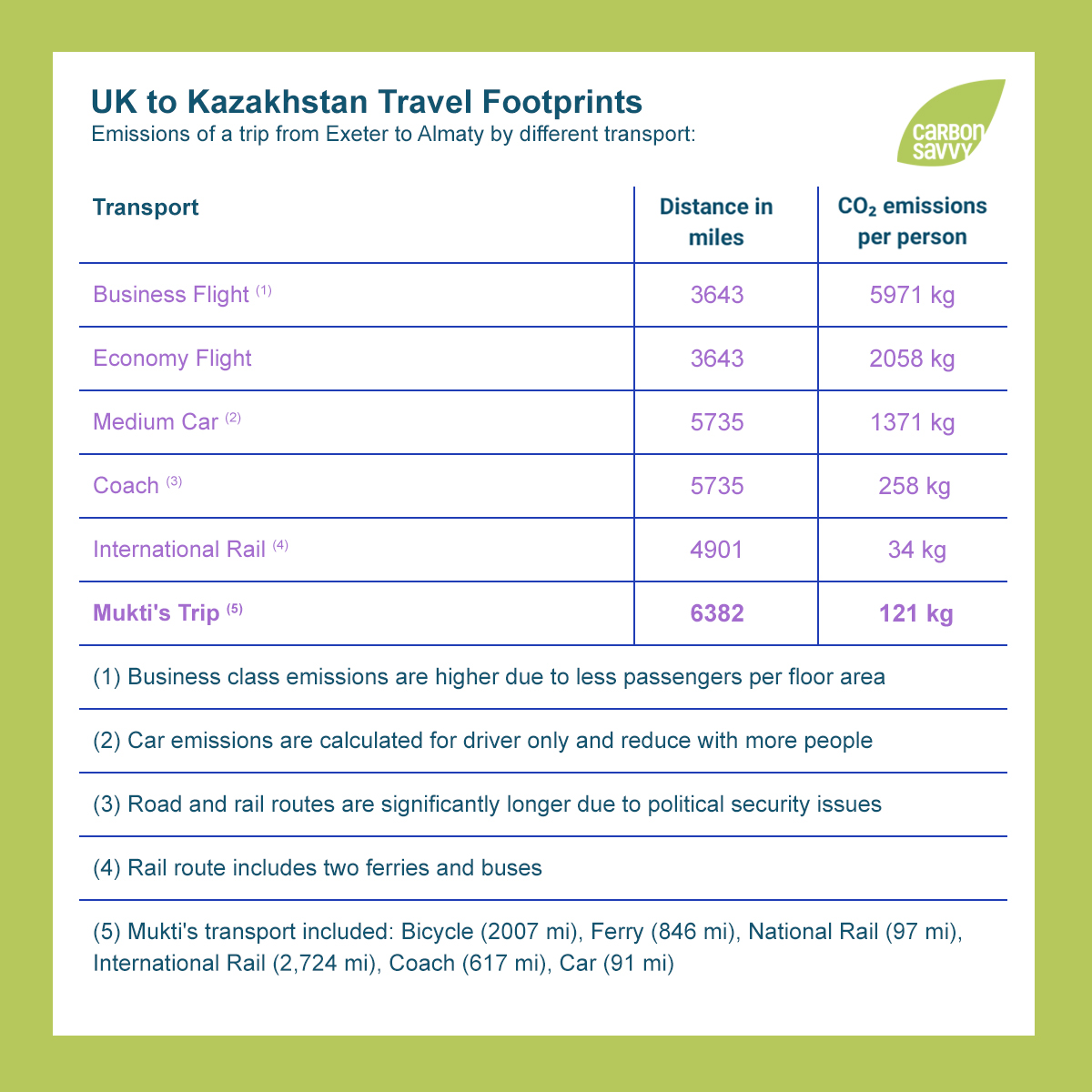
UK to Kazakhstan Travel Footprints
Inspired by a long land trip? Explore your own footprint with our world class carbon calculators, or browse more low carbon blogs on our website – your guide to high quality of life with a low footprint.
Wishing you a bright, outdoorsy Spring,
Mukti and the Carbon Savvy Team
Next steps
Sign up to our mailing list for more tips on enjoyable, low carbon living
Calculate your footprint for the first time or update it for the recent year
Send this article to a friend you think would enjoy it – Check out the ‘Share This Article’ options below!
Further reading
- Mukti’s low carbon journey to India – Part 1
- Mukti’s low carbon journey to India – Part 2
- Five inspiring low-carbon holidays
- The power of insulation