
Entering China!
Image: Mukti Mitchell
The Joy of Going Slow – Kazakhstan to India
In part four of my travelogue, I reach India after a journey of a year, a month a week and a day. You can read previous instalments here: Overland journey to India part 1, part 2 and part 3.
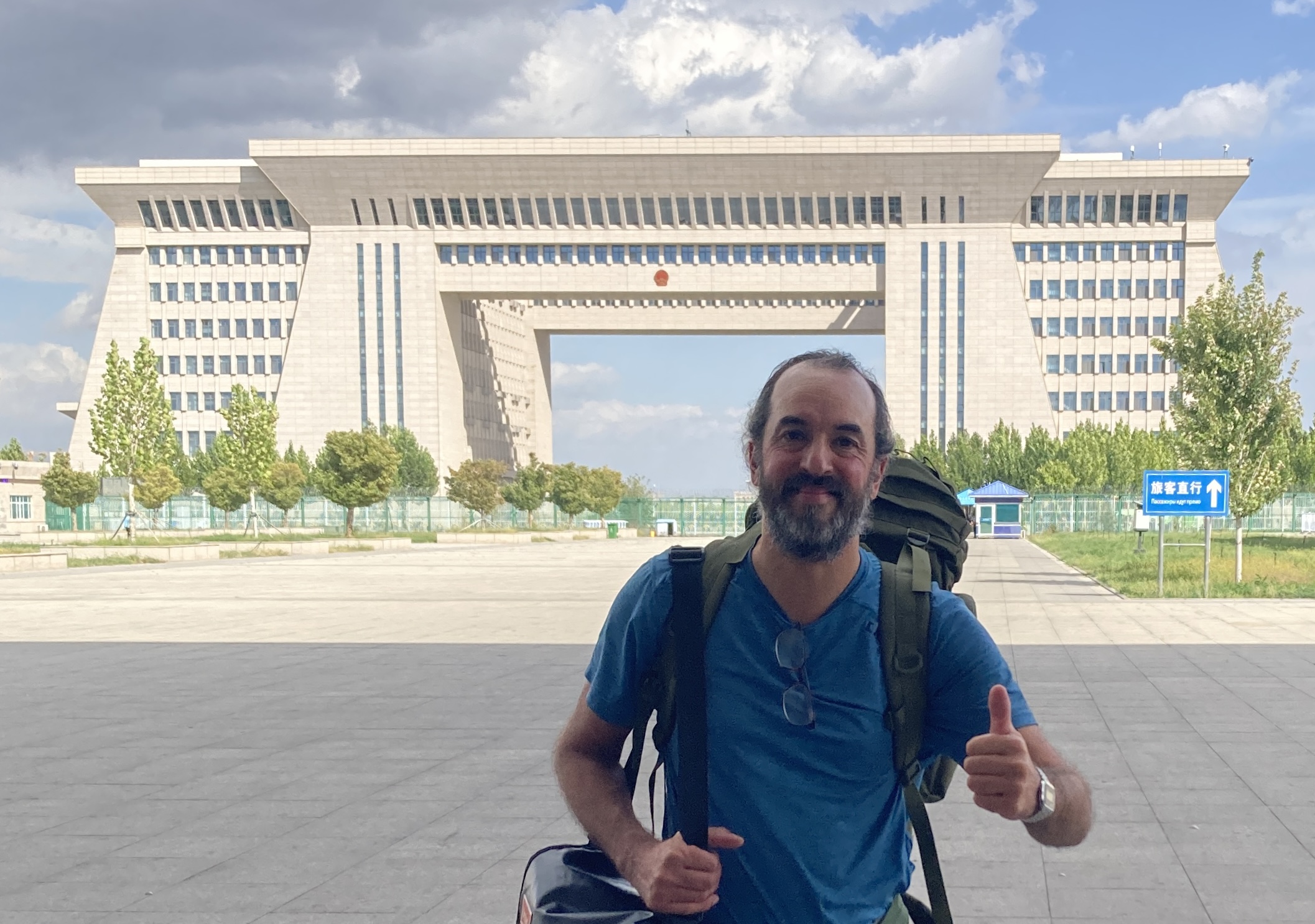
In September 2025, I took the 55-hour Trans-Kazakhstan railway from Aktau to Almaty. My love of farmers’ markets rewarded me with one of the best takeaways of my life at the city’s “Green Bazaar”. The next step felt big: Entering China! Arriving by bus, the border control was the most advanced I’ve seen – a vast hall of computerised immigration procedures, medical checks, digital finger-printing and a long list of patiently asked questions. My only loss was a lovingly-packed lunch of eggs, cheese, fruit and vegetables – “forbidden” – but I could keep the bread and nuts.
Stepping out of the bus at 7 am in Urumqi, I walked straight into a ramen restaurant and used a translation app to say, “I don’t eat meat, but I do eat eggs.” The young lady gave me a thumbs up and a couple of minutes later, I was slurping a vast bowl of freshly made noodles – hand-formed in 20 seconds. I was happy.
China impressed me with the cheerful laughter of street workers to whom I asked directions, deciphering my requests with AI translation apps that could even facilitate philosophical discussions. The women of Turpan rode hither and thither on electric scooters, beautiful dresses flowing in the warm breeze. Breakfast buffets presented vast arrays of vegetarian dishes – all-you-can-eat for a pound. Chengdu pointed to Europe’s future, with near-silent streets thanks to electric vehicles. Shuai, a young Chinese film-maker I met in Georgia, entertained me with food so abundant and delicious that my taste buds instantly knew why Chengdu is the food capital of China.

Shuai and the biggest dish of my life
Image: Mukti Mitchell
China had been a blank space on my mental world map and in three weeks it was filled with vibrant colour, exquisite tastes and human warmth. I found out that it now has the highest purchasing power parity in the world, so Chinese can buy more with their average salary than any other nation. I was flabbergasted by electric motorbikes priced at £500, a fraction of the cost in Europe. And it was incredibly safe: A young motorcyclist on a tour of China left his bags on his bike all night, every night outside the hostel – they would have been gone in an hour in most English cities. When I walked home late one night through a dimly lit park, neither a young woman nor an old couple took any notice of my presence – a silent signal of a complete absence of fear.
Tibet differed in two ways: Firstly a tension in people’s faces that I interpreted as dissent at the Chinese military presence. Secondly the profound strength of their faith in Buddhism. In Lhasa, on the circular walk around the central temple, Tibetans come from far and wide to walk or prostrate in continual procession. Seeing young mothers and tiny daughters prostrating the route together, which can take all day, moved me to tears. I was equally impressed by grandmothers performing hundreds of prostrations – effectively doing press-ups all day!
To get a Tibet Permit one must take a tour, so I joined a five-day organised trip to the Nepal border. While I prefer to travel freely, the guide was brilliant and my companions friendly. In Lhasa’s temples, I saw 10,000 Buddha statues in a day – a Tibetan reminder that every one of us is a Buddha in the making. Many Buddha statues are of women, including spiritual leaders of history equivalent to the Dalai Lama. In the palaces of the Dalai Lamas, the beauty and abundance of intricate decorative carvings and the lavish colours of the pillared halls left an impression of spiritual wealth that will stay with me forever. In contrast, the monks watching over altars, cleaning or simply smiling and chatting with visitors were always gentle and humble in a way that softened my heart.
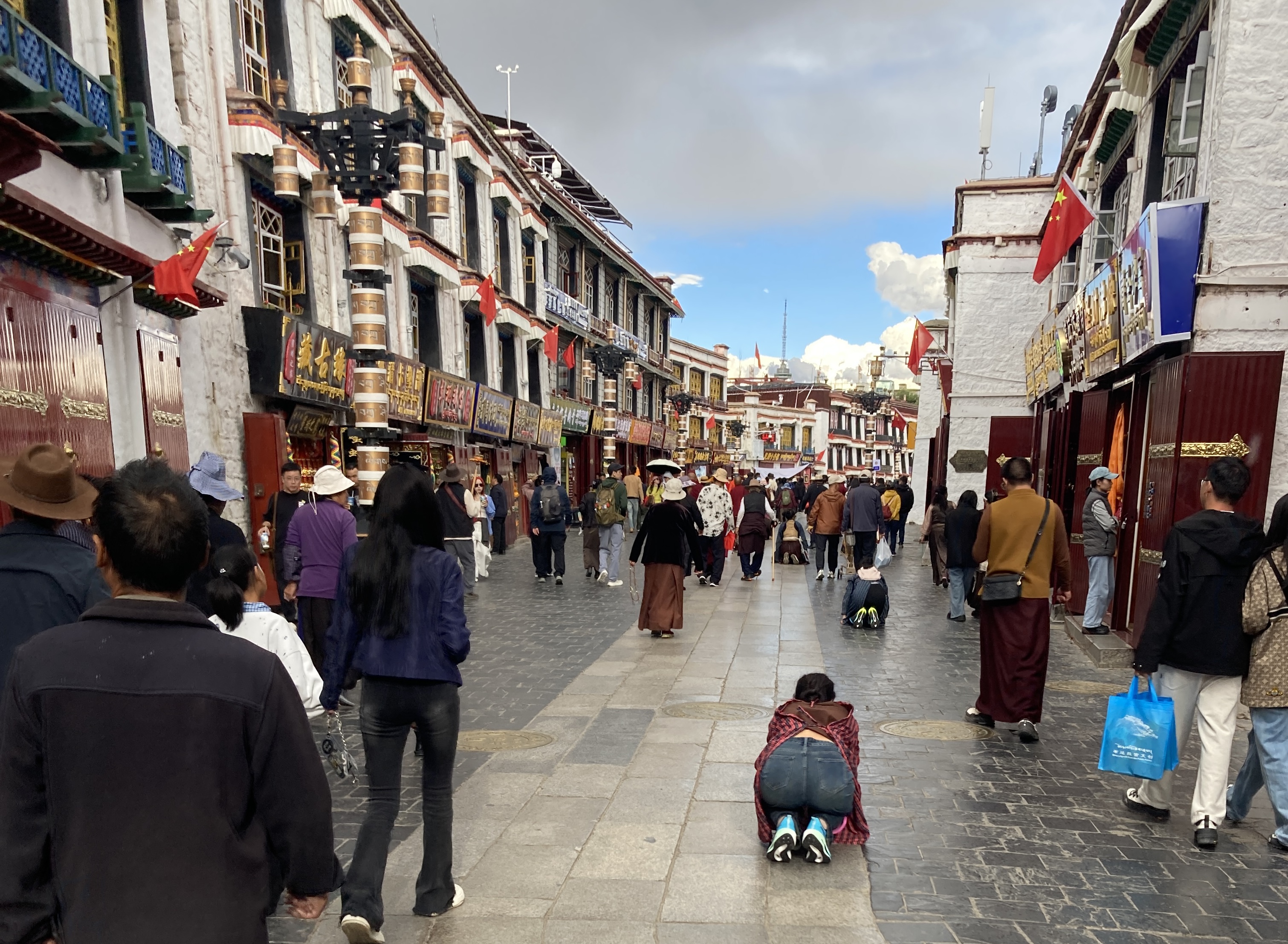
Processing and prostrating in Lhasa
Image: Mukti Mitchell
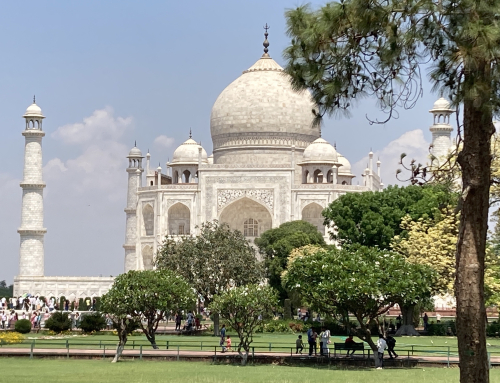
Next stop was the Tibet base camp of Mount Everest. Called “Mother Teacher” and “Mother Ocean” in Tibetan and Nepali, the great mountain, whose peak is at the height that jet planes cruise, left me with a deep impression of power and stillness.
To protect India from the floods of the river Ganges, whose source is deep in the Himalayas, Lord Shiva subdued the rains by catching them in the locks of his hair, which are the mountain forests of Nepal. Yet climate change is intensifying the annual rains that pour down on this small nation set in the world’s highest mountain range. Roads are routinely washed away in the monsoon season, at the end of which I arrived. This made the jeep ride from the Tibet Border to Kathmandu one of the most exciting of my life. Driving on makeshift mud roads beside drops of hundreds of meters, it took eight hours to cover a hundred kilometres.
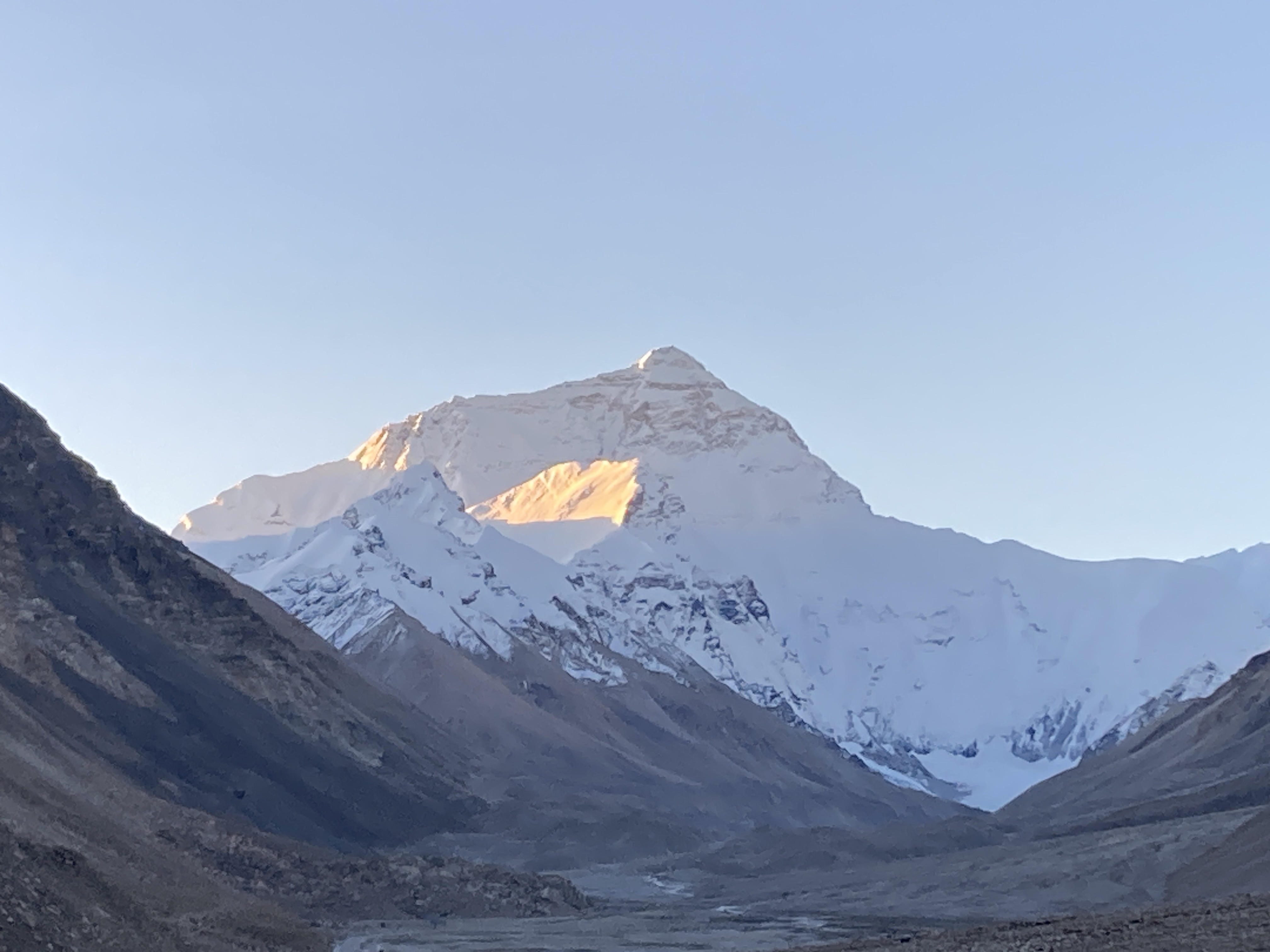
Dawn light on the world’s highest mountain
Image: Mukti Mitchell
Nepal felt like a step towards India, with women in colourful saris, abundant street life and a tropical warmth that contrasted the cool of Tibet. My final hurdle was Indian immigration simply because I needed a visa in one week instead of the usual three, to have a chance to meet my father in Delhi. By incredible good fortune and some help from the British Embassy, a visa miraculously materialised just in time.
On the way to India I stopped at the birthplace of the Buddha in Lumbini, a beautiful park with flowering trees, lakes, canals, and temples built by almost every nation in the world. In the middle lies the Maya Devi (mother of Buddha) temple where Buddha was born. I was inducted by a chanting priest wrapping a thread around my wrist, and my visit was complete.
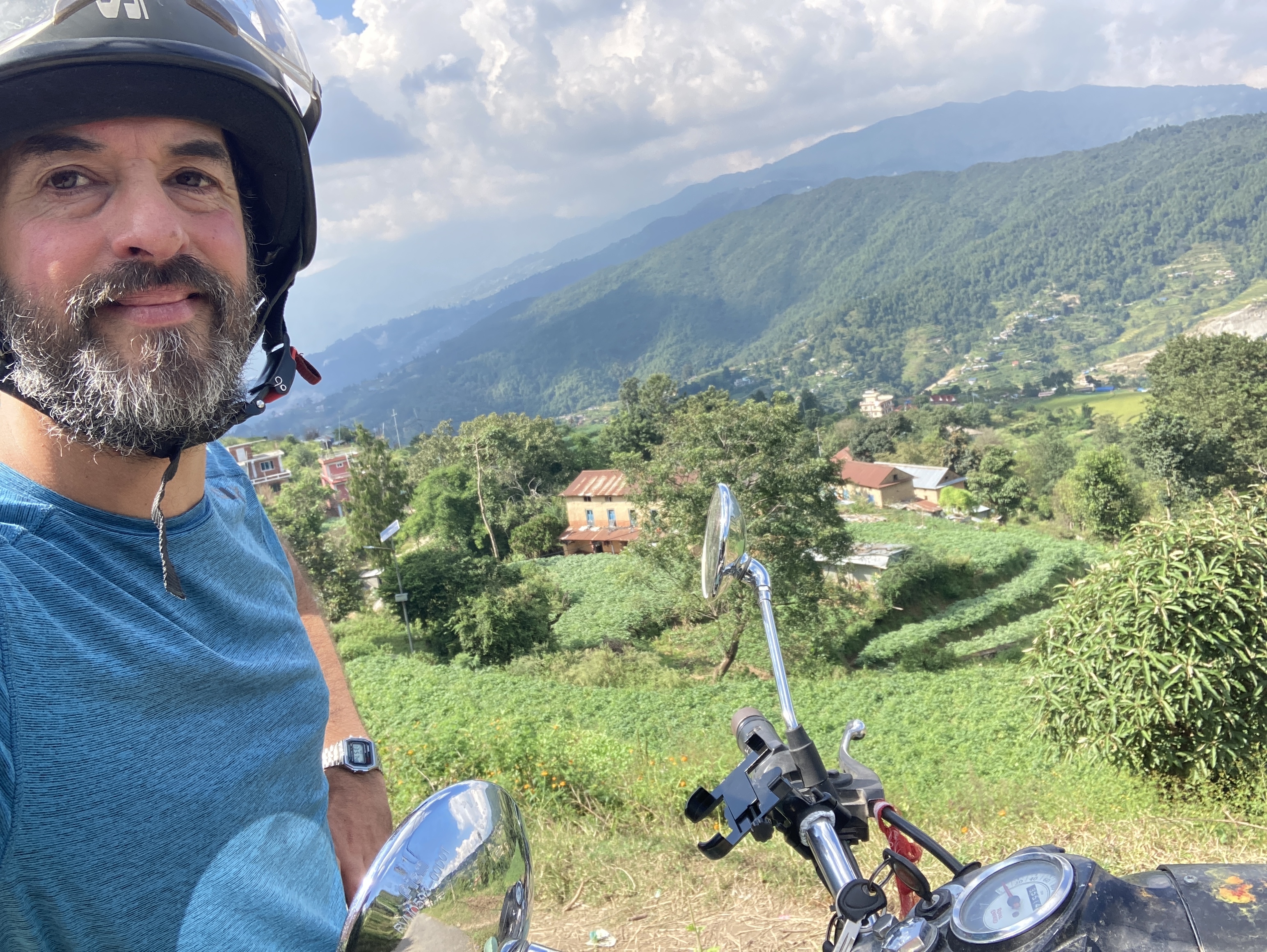
Exploring Nepal by Royal Enfield
Image: Mukti Mitchell
India, India. A friend says no words can explain India to someone who has not been. 1.4 billion people (more than the USA, Europe and Russia combined) with no social security, so everyone must earn a living. Five thousand years of civilisation – some say ten, back to the dawn of agriculture. A land of organic spirituality emerging from the depths of time, with countless gods and goddesses and an immense history of spiritual teachers. A land that has made the inner journey a principal focus for thousands of years. A land with all of the major religions and umpteen more spiritual paths. A land of ash-clad sadhu’s and tantric magicians, worshippers of goddesses and gods, devotees of divine nature and sacred sexuality, believers in asceticism and atheism. After a journey of a year, I feel I am at the beginning.
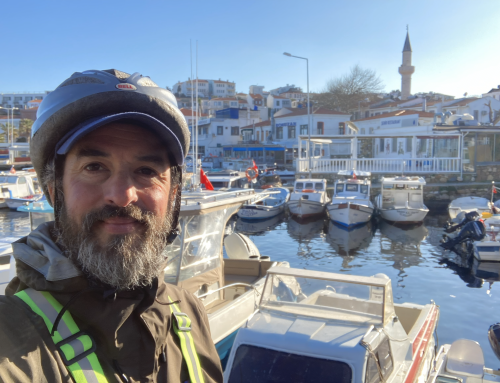
By a mix of effort and good fortune I somehow managed to complete the journey from Devon to Delhi without taking a single flight. My carbon footprint was 263kg compared to 4.5 tonnes of CO2 emissions for the return flight (14 tonnes business class). The experience has been unforgettable and I wouldn’t have missed a single day of the journey. Something I have deeply appreciated is not just seeing West and East, but every gradation in between. I travelled through 20 countries to get here, including UK, France, Switzerland, Liechtenstein, Austria, Italy, Slovenia, Croatia, Bosnia, Montenegro, Albania, Greece, Turkey, Georgia, Azerbaijan, Kazakhstan, China, Tibet, Nepal and India. As a result, the culture shock and physical sickness that I experienced on my last visit in 1992 were almost unnoticeable. From the very start I felt ready to discover India, and had a taste of the 20 countries on the way for context.
There is a vast difference in the carbon footprint of different forms of travel. International trains are fantastically efficient at just 3% of an economy flight! Here are the emissions of a range of transport alternatives for my journey:
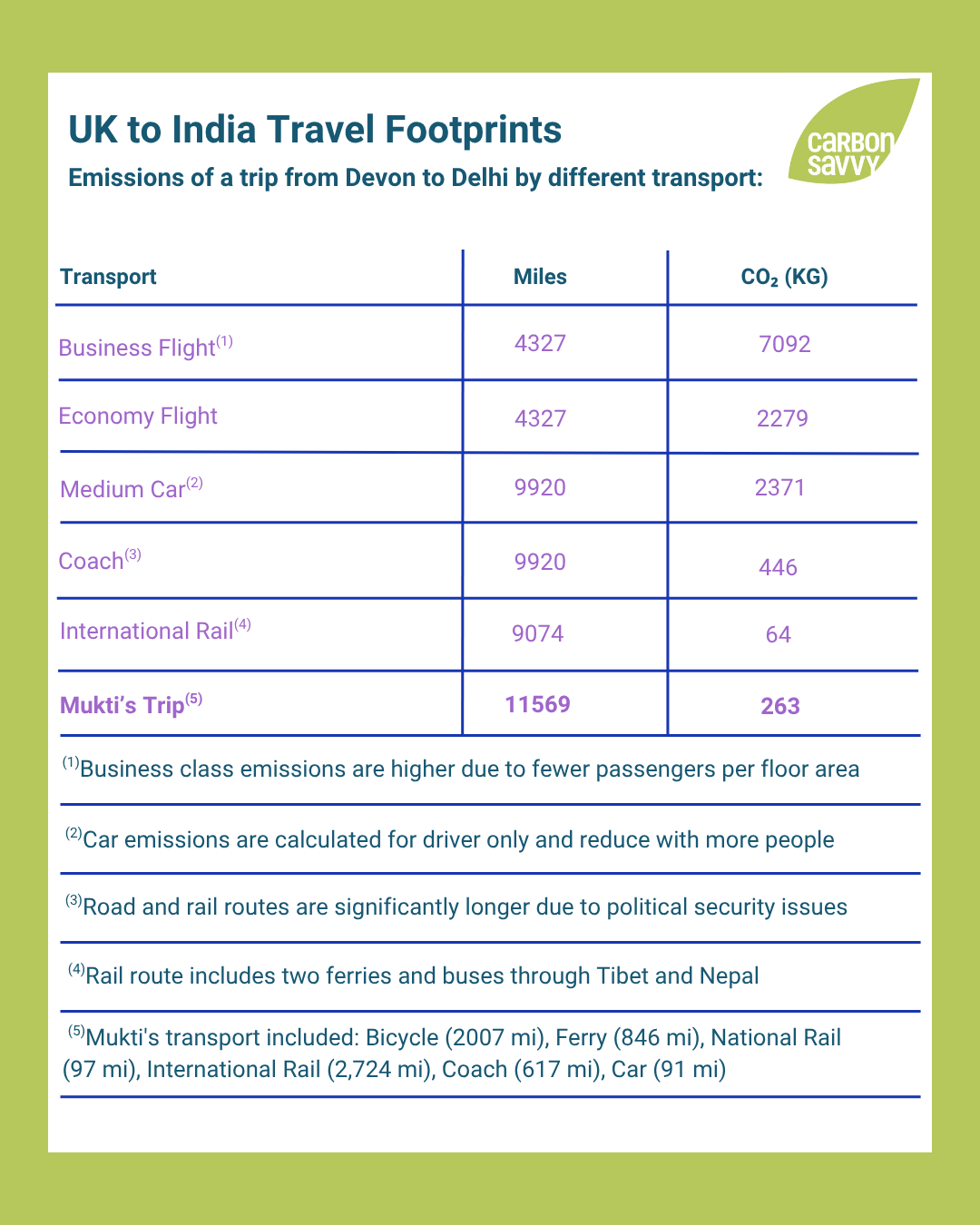
UK to India Travel Footprints
(All calculations done using the Carbon Savvy Full Calculator)
Inspired by a land trip or perhaps a staycation? Explore your own footprint with our world class carbon calculators, or browse more low carbon travelogues on our website – your guide to high quality of life with a low footprint.
Wishing you fun-filled, low-carbon summer explorations,
Mukti and the Carbon Savvy Team
Next steps
Sign up to our mailing list for more tips on enjoyable, low carbon living
Calculate your footprint for the first time or update it for the recent year
Send this article to a friend you think would enjoy it – Check out the ‘Share This Article’ options below!